Abstract
For decades, the boundaries of human breath-holding (apnea) were believed to be strictly limited by the brain’s high demand for oxygen. However, elite freedivers have shattered these biological assumptions. By utilizing specialized breathing techniques, pure oxygen enrichment, and triggering evolutionary survival mechanisms, humans have achieved the unthinkable: remaining underwater for close to 30 minutes. This article explores the scientific framework, physiological adaptations, and training methodologies that allow the human body to endure extreme periods of oxygen deprivation without sustaining neurological damage.
For decades, the boundaries of human breath-holding (apnea) were believed to be strictly limited by the brain’s high demand for oxygen. However, elite freedivers have shattered these biological assumptions. By utilizing specialized breathing techniques, pure oxygen enrichment, and triggering evolutionary survival mechanisms, humans have achieved the unthinkable: remaining underwater for close to 30 minutes. This article explores the scientific framework, physiological adaptations, and training methodologies that allow the human body to endure extreme periods of oxygen deprivation without sustaining neurological damage.
- 1. Introduction
To an untrained individual, a single minute without air feels like an eternity. Under normal circumstances, prolonged oxygen deprivation (hypoxia) leads to brain damage within four to six minutes. Yet, in the realm of elite freediving, athletes regularly surpass these limits. The ultimate display of this human capability is split into two categories recognized by international bodies like AIDA and Guinness World Records: Static Apnea (Normal Air) and Oxygen-Enriched Static Apnea.
- 2. Breaking the 29-Minute Barrier: The Role of Pure Oxygen
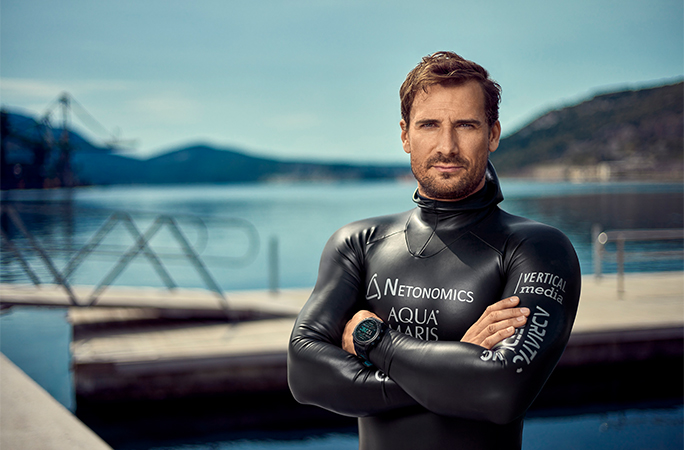
The absolute world record for remaining underwater stands at an astonishing 29 minutes and 3 seconds, achieved by Croatian freediver Vitomir Maričić. This feat falls under the “oxygen-enriched static apnea” category, a discipline that alters human biochemistry through a process called denitrogenation.
       [ Normal Air vs. Pure Oxygen Composition ]

   Normal Air                     Pure Oxygen Pre-breathing
+-----------------------+        +-----------------------+

|  Nitrogen (N2): 78%   |        |                       |
|                       |        |                       |
|  Oxygen (O2):   21%   |  --->  |     Oxygen (O2):      |
|  Other Gases:   1%    |        |        100%           |
+-----------------------+        +-----------------------+
- 2.1. Oxygen Hyper-Saturation
Before submerging, the athlete breathes 100% pure medical oxygen for up to 10 minutes. While normal air consists of roughly 21% oxygen and 78% nitrogen, this pre-breathing process flushes nitrogen out of the lungs and bloodstream. Consequently, it fully saturates hemoglobin and maximizes the amount of dissolved oxygen in the blood plasma. This creates an internal oxygen reservoir roughly five times larger than normal.
- 2.2. Masking the Urge to Breathe
The human brain does not monitor oxygen levels to trigger the urge to breathe; instead, it monitors the accumulation of carbon dioxide (\(CO_{2}\)) in the blood. Deep ventilation with pure oxygen dramatically lowers initial \(CO_{2}\) levels. Because the \(CO_{2}\) baseline starts so low, the brain remains unaware of the growing need for respiration for the first 15 to 20 minutes of the dive.
- 3. The Baseline: Static Apnea with Normal Air
When the variable of pure oxygen is removed, the limits of human physiology adjust to a different scale. The official world record for static apnea using normal atmospheric air is 11 minutes and 35 seconds, held by French freediver Stéphane Mifsud. For female athletes, the record is 9 minutes and 39 seconds, established by Germany’s Heike Schwerdtner.
Comparative Overview of World Records
The massive discrepancy between the two disciplines highlights the limiting factor of atmospheric nitrogen:
| Category | Gas Composition | Men’s World Record | Women’s World Record |
|---|---|---|---|
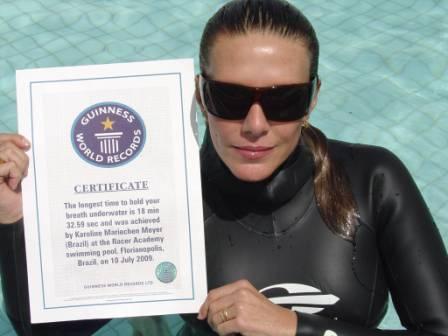
| Oxygen-Enriched Apnea | 100% Pure Oxygen | 29 min 03 sec (Vitomir Maričić) | 18 min 32 sec (Karoline Meyer) |
| Static Apnea (Normal) | 21% O₂, 78% N₂ | 11 min 35 sec (Stéphane Mifsud) | 9 min 39 sec (Heike Schwerdtner) |
- 4. Biological Survival Mechanisms: The Mammalian Dive Reflex
Once submerged, the human body ceases to act like a terrestrial mammal and instead mimics marine mammals such as whales and seals. This involuntary survival shift is known as the Mammalian Dive Reflex, and it is governed by two main pillars:
-
-
- Extreme Bradycardia (Heart Rate Deceleration): When cold water contacts the face, it stimulates the trigeminal nerve, prompting the vagus nerve to drastically slow the heart. Elite divers can lower their heart rate to an astonishing 10 to 15 beats per minute. A slower pulse directly correlates to drastically reduced oxygen consumption.
- Peripheral Vasoconstriction (Blood Shift): To protect the core, blood vessels in the extremities bicep, hands, and feet constrict. Blood is shunted away from non-essential muscle tissues and redirected entirely into a closed circuit feeding only the brain and the heart.
-
             [ Peripheral Vasoconstriction / Blood Shift ]

                 +-----------------------------------+

                 |               BRAIN               |
                 |       (Receives Oxygenated Blood) |
                 +-----------------+-----------------+
                                   |
                                   v
                 +-----------------+-----------------+

                 |               HEART               |
                 |       (Maintains Core Vitality)   |
                 +-----------------------------------+
                                   |
                X X X X X X X X X  x  X X X X X X X X X

                |                                     |
                v                                     v
     [ Constricted Vessels ]               [ Constricted Vessels ]
          Extremities                           Extremities
     (Hands / Arms / Legs)                 (Feet / Lower Body)
How does the brain survive up to 29 minutes without structural damage? The answer lies in advanced neuro-protection and psychological conditioning.
- 5.1. Hypoxic and Hypercapnic Tolerance
Through years of rigorous training utilizing “\(CO_{2}\) and \(O_{2}\) tables,” freedivers condition their central nervous system to tolerate extreme chemical imbalances. When \(CO_{2}\) reaches toxic thresholds around the 20-minute mark, the brain sends frantic signals, causing the diaphragm to undergo violent involuntary contractions (spasms). The athlete must remain completely calm during these spasms; panic raises the heart rate, causing an instant blackout.
- 5.2. Metabolic Downturn
During the initial “comfort zone” of the dive, athletes enter a meditative trance characterized by alpha brainwave activity. By lowering mental chatter and stress, the brain reduces its glucose and oxygen consumption to absolute minimum levels. If oxygen drops to critically dangerous levels, the brain activates its ultimate circuit breaker: syncope (blackout). By inducing unconsciousness, the brain shuts down all muscular metabolic demands, preserving its remaining oxygen strictly to keep brain cells alive until rescue.
- 6. Conclusion
The ability of a human to remain underwater for 29 minutes is not a medical miracle, but a masterclass in human adaptation. By combining the chemical advantage of pure oxygen pre-breathing with the evolutionary mechanics of the mammalian dive reflex, freedivers prove that the boundaries of human endurance are highly elastic. However, because these practices flirt with the thresholds of cellular death, they demand elite physical conditioning and strict professional medical supervision.