
 GeckoLib (Forge/Fabric/NeoForge) – Kurulum, Sürüm Seçimi, Hata Çözümleri
  Best Vanilla World 2 Modpack (NeoForge 1.21.1) – Kurulum
  Isle of Berk (Claws of Berk) Modpack Rehberi – 1.18.2 Forge Kurulum, Ejderha, Zindan ve İpuçları
  Roguecraft Datapack – Kurulum, Roguelite Run Sistemi, Yetenekler, Final Boss
  Repurposed Structures Friends & Foes Compat Datapack – Kurulum, Kullanım, Köylere Copper Golem + Beekeeper
  Spawn Animations Datapack Rehberi – Kurulum, Menü Komutları, Kullanım ve İpuçları
  Pastel Shaders Rehberi (Iris / OptiFine) – Kurulum, Preset Ayarları, FPS Optimizasyonu
  DawnCraft Modpack Rehberi (Forge) – Kurulum, Görev Sistemi ve Boss’lar
Starting a new Minecraft world is exciting, but for beginners, the first day can also feel stressful. You spawn with nothing, the sun starts moving immediately, and before you know it, night falls and hostile mobs appear everywhere. A lot of new players make the same mistake on Day 1: they waste time wandering, punching random blocks, or chasing animals without a plan. Then night comes, zombies knock on the door, skeletons start shooting, and the world that seemed peaceful turns into chaos.
The good news is that surviving your first day in Minecraft is not hard once you understand what actually matters.
You do not need a giant base on Day 1. You do not need iron armor, fancy farms, or perfect tools. Your real goal is much simpler: gather the right materials, secure food, make basic tools, build a safe shelter, and avoid unnecessary risks before night arrives. If you do those things in the right order, your first day becomes smooth, safe, and productive.
This guide is made for complete beginners, so everything is explained step by step in a simple way. By the end of this article, you will know exactly what to do from the second you spawn until the end of your first night. You will also understand what not to do, which is just as important if your goal is to stay alive.

Your Real Goal on Day 1
Many new players think Day 1 is about “progressing fast.” It is not. Day 1 is about survival efficiency.
Your main objectives are:
- Get wood immediately
- Craft basic tools
- Collect food
- Find a good temporary shelter location
- Gather stone and coal if possible
- Avoid combat unless necessary
- Survive the first night safely
If you focus on those seven things, you are already playing smarter than most beginners.
Think of Day 1 as the foundation for everything that comes later. A safe first day makes Day 2 much easier. A messy first day usually leads to panic, low hunger, bad gear, and repeated deaths.

The First 30 Seconds: Do Not Wander Aimlessly
The moment you spawn, stop for a second and look around. Do not run in one random direction immediately.
Ask yourself these questions:
- Am I near trees?
- Is there water nearby?
- Do I see animals like cows, sheep, or pigs?
- Is there a mountain, cave entrance, or village nearby?
- Is this area open and easy to move around in?
The best early spawn areas are usually plains, forests, and places near rivers. These biomes make it easier to gather wood, food, and building materials quickly.
If you spawn in a difficult biome such as a desert with little wood, a snowy area with fewer easy resources, or a jungle where movement is messy, your first job is still the same: find trees fast.
Your first priority is wood
Wood is the beginning of everything in Minecraft. Without wood, you cannot make:
- Crafting table
- Sticks
- Wooden tools
- Shelter components
- Torches later
- Chests
- Doors
Punch a tree and collect at least 8 to 12 logs right away. Beginners often stop after 2 or 3 logs, then realize they need more and waste extra time later. Save yourself the trouble and collect enough at the start.
A good Day 1 habit is this:
- First tree: survival
- Second tree: tools and shelter
- Third tree: extra safety and flexibility
You can always gather more later, but getting a decent stack early helps a lot.
Crafting Your First Tools the Smart Way
Once you have logs, open your inventory and turn them into wooden planks. Then craft:
- Crafting Table
- Sticks
- Wooden Pickaxe
A lot of beginners craft a full set of wooden tools immediately. That is not the best use of time.
Best early tool order
Craft tools in this order:
- Wooden Pickaxe
- Mine stone
- Upgrade to Stone Pickaxe
- Craft Stone Axe
- Craft Stone Sword if needed
- Craft Stone Shovel only if necessary
Why this order?
Because stone tools are much better than wooden tools, and stone is usually easy to get. So instead of wasting wood on a full wooden tool set, use the wooden pickaxe just to reach stone as quickly as possible.
Mine at least 17 to 20 cobblestone at the start. That gives you enough for:
- Stone pickaxe
- Stone axe
- Stone sword
- Furnace
- Extra blocks if needed
Why the stone axe matters so much
New players often overlook the axe, but on Day 1 it is one of your most useful tools. It lets you gather wood much faster, which means:
- Faster shelter building
- Faster crafting
- Less wasted daylight
In early survival, speed matters more than style.

Food Comes Earlier Than Most Players Think
One of the most common beginner mistakes is ignoring food until hunger becomes a problem. Then they start running around desperately trying to find animals when the sun is already going down.
Do not wait that long.
As soon as you have basic tools, start collecting food. On Day 1, your best food sources are usually:
- Sheep
- Pigs
- Cows
- Chickens
If you find berries in certain biomes, those help too, but meat is usually more reliable early on.
What food should you prioritize?
Not all food is equal. These are great early options:
- Cooked mutton
- Cooked porkchop
- Cooked beef
- Cooked chicken (good, but be careful not to eat it raw too often)
If you can, gather enough raw meat for at least 6 to 10 cooked food items before night.
That might sound like a lot for Day 1, but it is worth it. Hunger affects sprinting and health regeneration. If you are hungry and get attacked at night, your survival chances drop fast.
Should you kill sheep on Day 1?
Yes, often you should.
Some players hesitate because wool is valuable for beds. But sheep are actually one of the most useful early animals because they can give you:
- Food
- Wool for a bed
If you manage to collect 3 wool and a few wooden planks, you can craft a bed and skip the dangerous night entirely. That is one of the safest Day 1 strategies in Minecraft.
So yes, sheep are excellent Day 1 targets.

The Bed Strategy: The Easiest Way to Avoid a Disaster
If you can craft a bed before full night begins, your first day becomes dramatically easier.
To make a bed, you need:
- 3 wool
- 3 wooden planks
That is it.
A bed lets you sleep through the night, which means:
- Fewer mob encounters
- Faster start to Day 2
- Less panic
- Better health and hunger management
Important bed rule
You can only sleep when it is dark enough and when there are no hostile mobs close enough to disturb you. So if you want to use a bed safely:
- Place it inside shelter
- Close the entrance
- Light the area if possible
- Do not wait until mobs are already chasing you
If you get 3 wool early, consider the bed one of your biggest Day 1 wins.
Where Should You Build Your First Shelter?
Your first shelter does not need to be pretty. It only needs to be safe.
This is a lesson many beginners learn too late. They spend all day trying to build a beautiful starter house, then night comes before they finish the roof.
On Day 1, your shelter should be:
- Quick to make
- Easy to defend
- Close to resources
- Easy to expand later
Best Day 1 shelter locations
The best places for a first shelter are usually:
- Side of a hill or mountain
- Flat area near trees and animals
- Near water
- Near a cave entrance, but not deep inside it
- Near a village if you find one
Easiest shelter types for beginners
1. Dirt shelter
Ugly but effective. If night is coming fast, make a small dirt box with a door or just block yourself in.
Pros:
- Very fast
- Saves your life
- Uses easy materials
Cons:
- Not pretty
- Feels temporary
Still, survival comes first. A dirt shelter is better than dying with style.
2. Hill shelter
Dig into the side of a hill and create a small room.
Pros:
- Fast
- Safe
- Easy to expand
- Good for first furnace setup
Cons:
- Less visibility outside
This is one of the best beginner shelters because it gives protection quickly and uses the terrain naturally.
3. Tiny wooden cabin
If you have enough wood and time, a small wooden cabin works well.
Pros:
- Looks better
- Easy to organize
- Good starter base
Cons:
- Takes longer than digging into a hill
- More exposed if rushed
For most beginners, a hill shelter is the safest and smartest Day 1 choice.
What Size Should Your First Shelter Be?
Keep it simple.
A good first shelter can be as small as:
- 5×5 inside space
- room for a bed
- crafting table
- furnace
- chest later
That is enough.
You do not need multiple rooms, windows everywhere, a second floor, or decoration on Day 1. Overbuilding is one of the fastest ways to waste your daylight.
The best mindset is this:
Day 1 shelter is for survival, not for showing off.
You can always improve it on Day 2 or Day 3.
Stone, Coal, and Why Torches Matter More Than You Think
If you still have daylight after getting food and making shelter, your next important goal is gathering more stone and, if possible, coal.
Why coal matters
Coal lets you make:
- Torches
- Better cooking fuel
Torches are one of the biggest quality-of-life upgrades in early survival because they:
- Prevent some mob spawns in your shelter
- Help you see at night
- Make mining safer
- Reduce panic in dark spaces
If you cannot find coal on Day 1, do not panic. You can still survive by using:
- Wooden planks as temporary fuel
- Charcoal made by smelting logs
How to make charcoal
If you have a furnace but no coal:
- Put logs in the top slot
- Put wooden planks or other fuel in the bottom slot
- Smelt logs into charcoal
Charcoal works exactly like coal for torches and fuel purposes.
This is an excellent beginner trick and one of the easiest ways to avoid total darkness on your first night.

Should You Enter a Cave on Day 1?
Usually, only very carefully.
Caves are tempting because they offer:
- Coal
- Stone
- Iron if you get lucky
But for new players, caves are also one of the fastest ways to die. Darkness, fall damage, skeleton arrows, hidden creepers, and getting lost can end a promising world quickly.
Day 1 cave rule
Only enter a cave if:
- The entrance is shallow and visible
- You have enough food
- You have stone tools
- You still know where your shelter is
- You are not rushing because sunset is close
If the cave drops deep quickly or becomes dark fast, do not go in. Grab what is near the entrance and leave.
There is no shame in playing safely. Minecraft rewards patience more than reckless bravery.
If You Find a Village on Day 1, What Should You Do?
Finding a village on your first day is amazing.
Villages can provide:
- Beds
- Food
- Shelter
- Villagers for future trading
- Useful blocks
- Early safety
Best Day 1 village strategy
If you find a village, do these things:
- Take a bed if needed
- Check houses for useful materials
- Use the village as temporary shelter
- Gather nearby hay bales if available for food
- Stay alert at night because mobs can still appear around the village
Hay bales are especially useful because you can turn them into wheat, and wheat can become bread. This can solve your early food problems very quickly.
Should you live in a village immediately?
You can, but not always permanently.
Villages are great early-game survival spots, but some players prefer building their own base nearby rather than inside the village. For Day 1, though, a village is absolutely one of the safest places you can use.

What You Should Never Do on Your First Day
Knowing what to avoid is one of the biggest beginner advantages. Here are the most common Day 1 mistakes.
1. Running in random directions for too long
Exploration feels fun, but if you do it without purpose, you waste precious daylight and may lose your spawn area.
2. Building a giant house immediately
A giant unfinished house is worse than a tiny finished shelter.
3. Fighting every mob you see
You do not need to prove anything on Day 1. Survival is the mission.
4. Ignoring food
Low hunger leads to low sprinting, weak recovery, and panic.
5. Staying outside after sunset
Even skilled players respect the first night. Beginners should be extra careful.
6. Entering deep caves too early
The loot is not worth losing your first world over.
7. Forgetting a bed opportunity
If you find sheep and ignore the wool, you are making your first night harder than it needs to be.
8. Using all your wood carelessly
Wood is needed for tools, sticks, shelter, fuel, and crafting. Always keep extra.
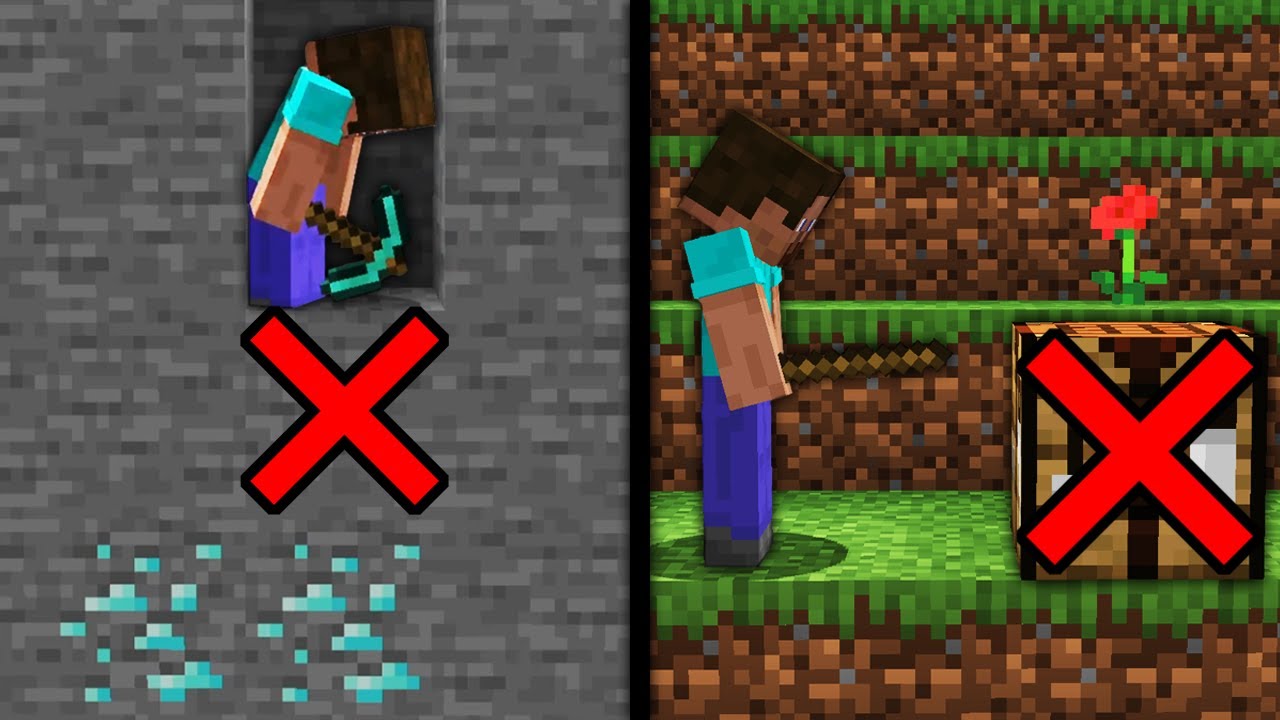
9. Digging straight down
Never do this. You can fall into caves, lava, or deep drops.
10. Carrying everything while taking risks
If you plan to test a dangerous cave or area, store your most valuable items first.

A Simple Minute-by-Minute Day 1 Plan
If you want a very easy beginner structure, follow this timeline.
Minute 0 to 2: Spawn and scan
- Look around
- Find trees
- Check for animals, water, hills, or village
Minute 2 to 5: Gather wood
- Collect 8 to 12 logs
- Make planks
- Craft table
- Craft sticks
Minute 5 to 8: Upgrade to stone
- Make wooden pickaxe
- Mine cobblestone
- Craft stone pickaxe and stone axe
- Make stone sword if desired
Minute 8 to 13: Gather food
- Kill sheep, pigs, cows, or chickens
- Collect wool if possible
- Keep moving efficiently
Minute 13 to 17: Choose shelter spot
- Prefer hill, cabin site, or village
- Stay near resources
- Avoid building too far from trees and animals
Minute 17 to 22: Build shelter
- Make a small safe room
- Place crafting table
- Make furnace
- Add door if possible
Minute 22 to 26: Cook food and prepare night setup
- Smelt food
- Make charcoal if no coal
- Craft torches if possible
- Place bed if you have one
Minute 26 to 30: Lock in survival
- Go inside before full dark
- Sleep if possible
- If not, stay safe and organize inventory
This kind of structure keeps you focused and prevents the classic beginner spiral of “I did a little of everything but nothing properly.”

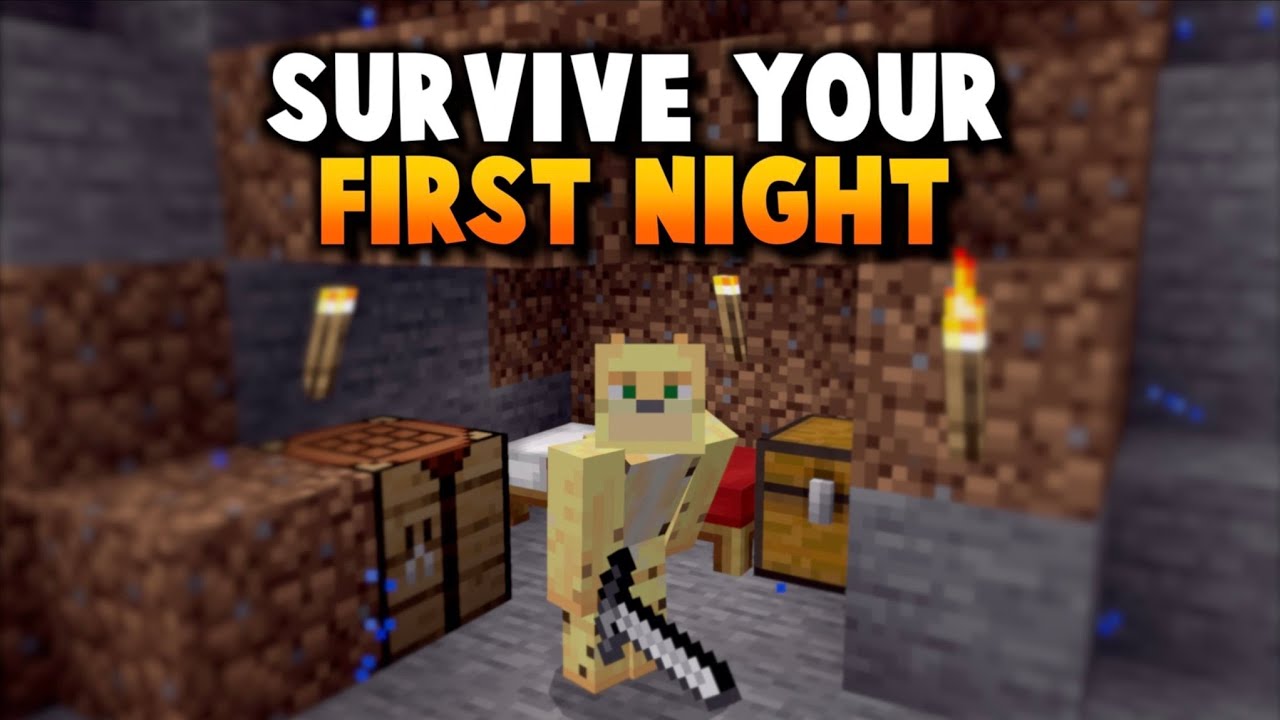
How to Survive the First Night If You Do Not Have a Bed
Sometimes things do not go perfectly. Maybe you found only two sheep. Maybe night came too fast. Maybe you spawned in a weird biome.
That is okay.
You can still survive the first night without a bed.
Best no-bed survival plan
If you do not have a bed:
- Go inside your shelter before mobs fully appear
- Seal entrances
- Place torches if you have them
- Cook food
- Craft extra tools
- Smelt materials
- Expand your shelter carefully
- Wait for daytime
This is the safest approach.
Should you fight mobs outside?
Not unless you have a good reason.
On the first night, mobs are more dangerous than useful for beginners. Yes, they drop loot, but surviving is more important than early drops.
What if mobs are outside your door?
Stay calm. Do not rush out.
You can:
- Wait for daylight
- Listen for sounds
- Open carefully only when safe
- Use small openings to look outside if needed
Patience wins.
Which Mobs Are the Biggest Day 1 Threats?
Not all hostile mobs are equally dangerous for beginners.
Zombie
Zombies are slow and simple, but they are dangerous if you get cornered or fight multiple at once.
Skeleton
This is often the most dangerous early mob for beginners. Skeletons attack from range, their arrows hurt, and they can knock you back.
Creeper
Creepers are silent, which makes them terrifying for new players. A single surprise explosion can ruin your shelter, destroy items, and kill you if your health is low.
Spider
Spiders are fast and can climb. They are especially dangerous in open spaces, though sometimes easier to avoid.
Main rule
On Day 1, avoid fighting unless you must. A perfect kill still carries risk. An unnecessary fight is often a bad trade.
Inventory Tips That Make Day 1 Easier
Inventory management sounds small, but it helps a lot.
Keep these items ready:
- Food in easy reach
- Blocks for emergency pillar or wall
- Pickaxe
- Axe
- Sword
- Crafting table
Try not to fill your inventory with junk immediately. Keep useful materials only.
Good Day 1 materials to keep
- Wood/logs
- Cobblestone
- Coal or charcoal
- Raw and cooked food
- Wool
- Seeds if convenient
- Dirt for emergency building
Things not worth stressing over on Day 1
- Rare flowers
- Large amounts of sand
- Decorative blocks
- Massive dirt stacks
- Niche items with no immediate survival use
Stay practical.

The Best Beginner Mindset: Safe Progress Is Fast Progress
Many beginners believe moving cautiously means progressing slowly. In Minecraft, the opposite is usually true.
If you rush and die:
- You lose time
- You lose location awareness
- You may lose items
- You may panic and make worse decisions
If you play safely:
- You keep resources
- You stay organized
- You begin Day 2 stronger
- You build momentum
The player who survives cleanly on Day 1 will usually outperform the reckless player by Day 3, even if the reckless player seemed faster at first.
What a Successful Day 1 Looks Like
By the end of your first day, a strong beginner setup usually includes:
- A safe shelter
- Stone tools
- A furnace
- Enough food for the next day
- Possibly a bed
- Some extra wood
- Some stone and maybe coal or charcoal
- Full health or near full health
- No unnecessary deaths
If that is your position when Day 2 begins, you are doing great.
You do not need iron on Day 1 to succeed. You do not need diamonds. You do not need a giant base. You only need a secure start.
That is how survival worlds become long-term worlds instead of “I died and made a new world again.”
Beginner FAQ
How much wood do I need on the first day in Minecraft?
A good starting amount is around 8 to 12 logs, but more is always useful. Extra wood gives you flexibility for tools, shelter, sticks, fuel, and emergency crafting.
Is a bed necessary on Day 1?
Not necessary, but extremely helpful. A bed lets you skip the dangerous first night and makes the early game much easier.
Should I build with wood or dig into a hill first?
For beginners, digging into a hill is usually safer and faster. A small wooden house is fine too, but only if you have enough time before night.
What is the safest food on Day 1?
Cooked beef, cooked porkchop, and cooked mutton are some of the best easy foods. Bread is also useful if you find a village with hay bales.
Should I mine on the first day?
Yes, but only a little. Get stone early, grab coal if it is easy to reach, and avoid deep cave exploration until you are better prepared.
Is it okay to hide in a dirt house?
Absolutely. It may not look impressive, but survival matters more than appearance on the first day.

Surviving Day 1 Is About Discipline, Not Luck
Minecraft can feel random when you are new, but surviving your first day is not about luck as much as people think. It is mostly about making good decisions in the right order.
If you:
- get wood early,
- upgrade to stone fast,
- collect food before hunger becomes a problem,
- build shelter before dark,
- and avoid unnecessary risks,
then your first day becomes manageable, even relaxing.
The most important thing to remember is this: you are not trying to do everything on Day 1. You are trying to survive well enough that Day 2 becomes easy.
That is the real beginning of a successful survival world.