[ad_1]
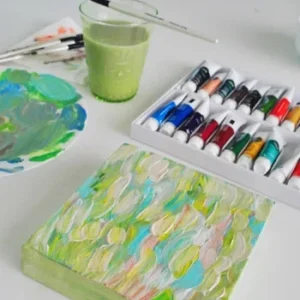
What is it about painting that makes me suddenly feel all French-beret and inspired? Whatever the reason, I finally tackled one of the enormous 40 x 30″ canvases I picked up at Michael’s when it was deeply discounted—$23 after stacking a 50% off promotion with an extra 25% off. After spotting an inspirational poster design online (thanks to a Pinterest find), I decided to adapt it for a wide-format canvas and have some fun with a few inexpensive paint samples from Lowe’s. I spent about $9 on three tester pots and mixed them with white craft paint I already had to create a variety of tints from just a handful of hues.
To begin, I used a yardstick to mark evenly spaced vertical guidelines across the canvas, simply measuring by the width of the yardstick to keep the intervals consistent. I penciled those lines in lightly so they could be painted over later.
Next, I used the corner of a small card we had lying around to form angled peaks, echoing the prism-like shapes from my inspiration piece. Using a rigid right-angle card was an easy, low-tech way to get repeating triangular forms and keep the geometry loose and handmade rather than perfectly mechanical.
Once the grid and peaks were laid out, I filled each shape with different shades of blue and green. The testers I used were Behr’s Tropical Waters, Embellished Blue, and Thermal Spring, blended as needed with white craft paint to create lighter tints and subtle variations. The initial result felt lively and energetic—full of contrast and punch—but after stepping back I realized the contrast was a touch too strong for the subtle aesthetic I wanted.
One of the best parts of painting is that nothing is permanent: if you don’t like a section, you can paint over it. I mixed a softer green-gray and went over many of the darker green areas to create a more tonal, restrained effect. The revised palette is more tone-on-tone and nuanced, with imperfect lines and visible brush strokes that make the piece feel handmade and personal.
I love how the painterly texture and the variety of related hues give the work depth while still feeling cohesive. The only problem is placement: the canvas doesn’t sit right on our bedroom wall because the wall color is a similar soft blue-green. At first I thought the tone-on-tone effect would layer nicely, but in this case it made the whole corner feel too monochrome and muted. For now we’re considering moving the painting to the dining room above a large buffet or console near the front entry, or possibly another spot that provides a stronger contrast to the wall. In short, I prefer tone-on-tone art when it isn’t mounted on a wall of the same tone.
The project took longer than I expected. What I thought would be an evening or two stretched into four or five sessions of about two hours each. Even so, I almost didn’t want it to end. Painting felt familiar and joyful—an old habit revived. It stirred memories of my high school and college art classes; I took every art course available in high school and then went to art school in New York City, where I ended up with a BFA in Advertising Design. Using house paint testers felt delightfully economical after years of being accustomed to pricier professional materials.
On a related note, one of my drawing professors in school once nicknamed me “the narrator of life” because I would narrate my process out loud while working—little asides like “oops, I dropped my charcoal” or “now for the foreground.” I mostly spoke under my breath, but when he asked what I was saying I realized I had been verbalizing everything. At the time the nickname embarrassed me, but these days I find it oddly fitting: my creative life often feels like an ongoing narration. It’s amusing to think of reconnecting with that professor to share where life has taken me—though I might keep the detail about using house paint testers to myself. It feels a bit scandalous for an art-school grad, but also satisfying and practical.
All in all, this canvas reminded me why I enjoy painting: the process is forgiving, the outcome can evolve, and the act itself is restorative. I’m already thinking about the next piece and where it might show up in our home. Have you painted anything recently? If you’ve got a canvas waiting, dive in—you may be surprised how quickly the habit comes back.
[ad_2]